Siege of Mazagan (1769)
The final siege of Mazagan in early 1769 — Sultan Mohammed ben Abdallah's 70,000 men and 35 cannon against 592 Portuguese under Dinis Gregório de Melo Castro e Mendonça; the negotiated evacuation of 11 March, the mining of the bastions with ~40 barrels each, and the explosion that killed about 5,000 Moroccans and left the city al-Mahdouma (the Ruined).
Siege of Mazagan (1769)
The Siege of Mazagan (1769) — early 1769 to 11 March 1769 — was the last engagement of the 354-year Moroccan–Portuguese conflicts and the end of Portugal’s presence in Morocco. The ‘Alawite Sultan Mohammed ben Abdallah (Mohammed III), refusing to acknowledge Portuguese rule over his coast, invested the fortress with 70,000 men and 35 cannon during Ramadan, and after a bombardment of 2,000 round shot forced the evacuation of Portugal’s last square in Morocco.
Quick Facts
| Attribute | Value |
|---|---|
| Date | Early 1769 – 11 March 1769 (evacuation); squadron left Lisbon 1 February |
| Location | Mazagan (33°14′N 8°30′W) |
| Belligerents | Kingdom of Portugal vs. Sultanate of Morocco (‘Alawite) |
| Commanders | Dinis Gregório de Melo Castro e Mendonça (governor), Bernardo Ramires Esquível (sea captain, 54-gun Nossa Senhora de Belém e São José) vs. Sultan Mohammed ben Abdallah |
| Strength | Portuguese: 592 men — 472 infantry, 99 cavalry, 21 artillery (including facheiros/atalhaias); Moroccan: 70,000 men, 35 cannon |
| Result | Moroccan victory — negotiated evacuation; fortress mined and partially destroyed |
| Casualties | Portuguese: unknown (evacuated); Moroccan: ~5,000 dead in the post-evacuation explosion (an-Nasiri / Carlos Nunes Silva); plus bombardment losses |
| Aftermath | City uninhabited ~50 years as al-Mahdouma; 2,092 evacuees shipped to Lisbon 21–24 March, >300 died in hospitals; survivors founded Vila Nova de Mazagão (Mazagão Velho, Amapá, Brazil) in 1773 |
Background
By 1769 Mazagan — built as a superfortress in 1541–42 — was Portugal’s last possession in Morocco. Ceuta remained Spanish since 1640, Tangier had been ceded to England 1661, Safi and Azamor abandoned 1541. The garrison of 592, though complete on paper, reflected Lisbon’s already-weighed decision to abandon — José I, advised by the Marquês de Pombal, had quietly reduced the Moroccan establishment for six years (Silva 2004:173).
The walls — 275 × 200 m rectangle, five bastions, 12 m thick scarps, 20 × 3 m wet ditch with buxas — remained formidable, but without relief the 592 could not man the 69 embrasures, the covered way (Q), the revelim (P) and the 38-ha outer field at once.
The Siege
Sultan Mohammed ben Abdallah arrived in Ramadan with the ‘Alawite mhalla, 35 cannon prepared and 2,000 round shot fired into the city, inflicting heavy casualties and damage. The garrison wrote to King José I asking aid. José ordered evacuation — take everyone and their families. The inhabitants first refused — “their ancestors had sacrificed themselves to keep it” — then complied and asked the Sultan for three days to evacuate. Mohammed accepted on condition they leave everything behind (an-Nasiri VIII:37).
On 1 February a squadron under captain of sea and war Bernardo Ramires Esquível sailed from Lisbon to lift the population (Pereira 2011:97–99): the 54-gun ship of the line Nossa Senhora de Belém e São José (flagship, Esquível), frigates Nossa Senhora da Nazaré and da Guia, charruas Nossa Senhora das Mercês and Santa Ana e São Joaquim, and five yachts.
During the three days the Portuguese burned furniture and bedding, killed livestock and broke tools (an-Nasiri:37), then — violating the agreement (Carlos Nunes Silva) — mined the bastions with ~40 barrels of gunpowder in each and the main entrance, burying charges. Embarkation completed 11 March; the last off was Governor Dinis Gregório. Left behind, by tradition, was a man called “Pedro”, said to have fired the train as Moroccans entered, killing ~5,000 (an-Nasiri:37; Silva). The Governor’s Bastion and a long curtain of the main rampart were devastated.
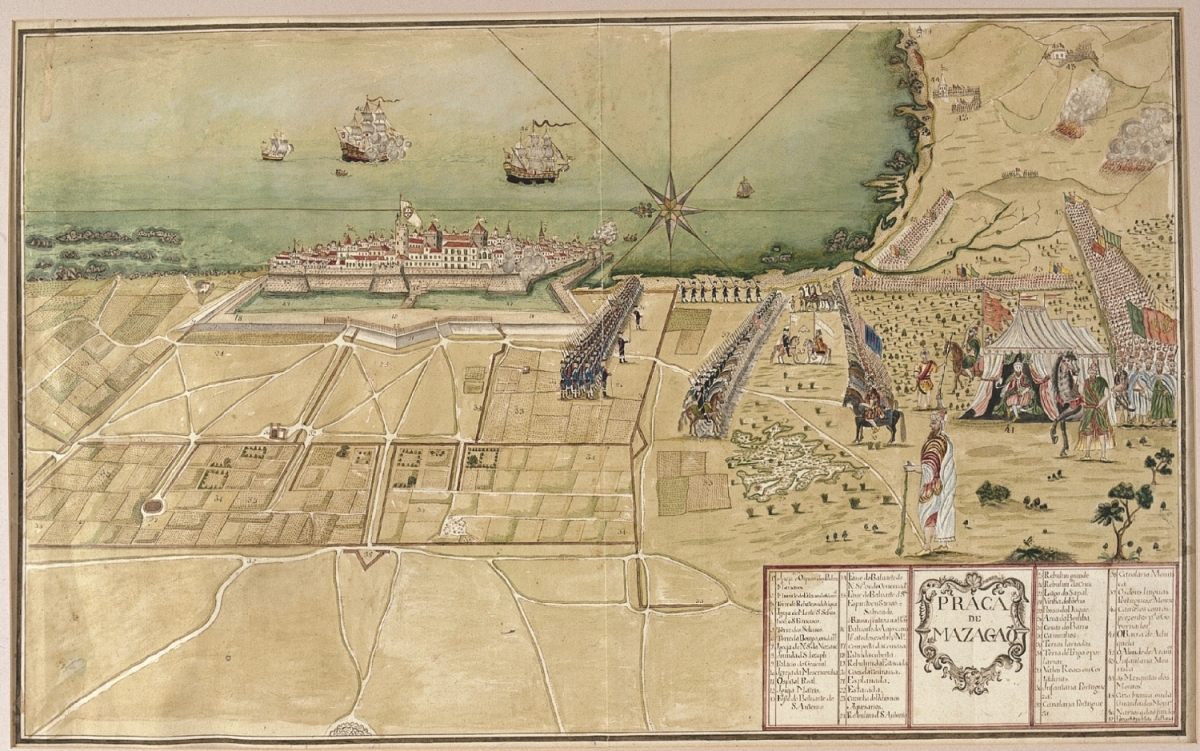 Praça de Mazagão, 18th-century plan showing the tribal camps stationed around the fortress to liberate it — the Sultan’s 70,000 encircling the 592. File:Praça de Mazagão.jpg (public domain, via históriasdeportugalemarrocos.com).
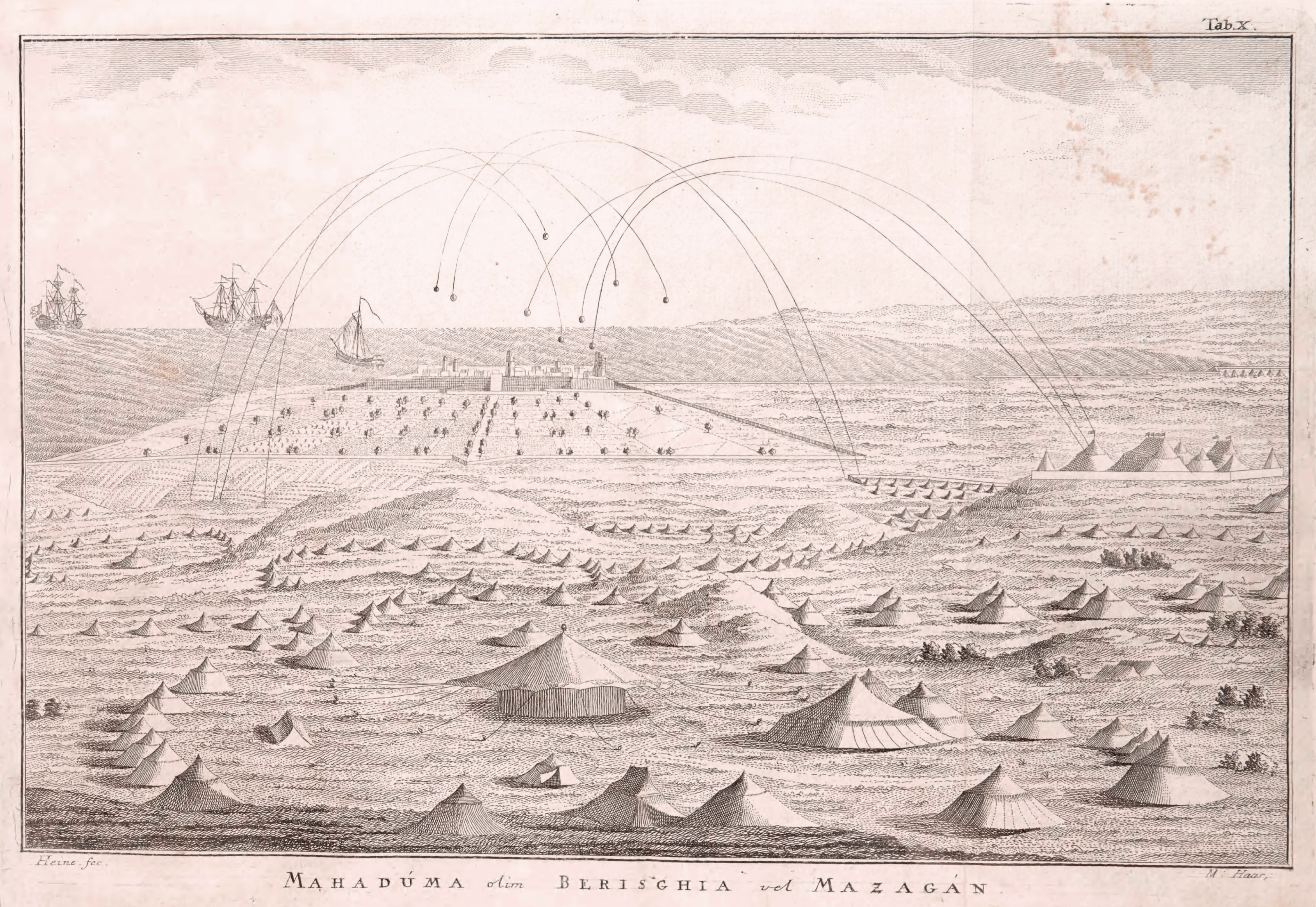 Peter Haas, engraving of the 1769 siege in Georg Hjersing Høst, Efterretninger om Marokos og Fes (1779) — titled Mahadúma Berisghia Mazagán (public domain, via archive.org).
Aftermath
The squadron anchored at Lisbon 21–24 March; the evacuees were fed at royal expense “with dinner and supper” but housed miserably; more than three hundred died in hospitals (Pereira 2011). The survivors were shipped to Brazil where in 1773 they founded Vila Nova de Mazagão in the interior of Amapá, State of Grão-Pará and Rio Negro (today Mazagão Velho).
The city lay uninhabited nearly half a century as El-Mahdouma (the Ruined) (UNESCO nomination 2004). Early in the 19th century Sultan Moulay Abd al-Rahman ordered the Pasha to rebuild the destroyed portions (in a slightly different bond), build a mosque, and rehabilitate the city; in 1820 the name Mazagan was banned and the city became El-Jadida (the New) (FAR 128–133; Starforts: Mazagan). The minaret reused the old Torre de Rebate. Under the French Protectorate the quarter became the Cité Portugaise, the moat was filled.
In 2004 the Portuguese City of Mazagan was inscribed UNESCO World Heritage — “an outstanding example of the interchange of influences between European and Moroccan cultures” — and today ~3,700 live inside the walls.
Related Entries
Locations
- Mazagan Fortress — the fortress besieged and evacuated
Characters
- Dinis Gregorio de Melo Castro e Mendonca — last governor
- Bernardo Ramires Esquivel — squadron commander
Sources
- Wikipedia, Siege of Mazagan (1769) — dates, strengths, commanders, squadron composition (Pereira 2011), an-Nasiri VIII:35–37, Carlos Nunes Silva;
- Ahmad ibn Khalid an-Nasiri, al-Istiqsa li-Akhbar duwal al-Maghrib al-Aqsa, Vol.VIII;
- Pedro Miguel Nazaré Pereira (2011), Bernardo Ramires Esquível, Univ. Lisbon, pp.97–99;
- UNESCO nomination, Proposition d’inscription: Cité portugaise Mazagan (El Jadida) (2004);
- Histórias de Portugal em Marrocos, Mazagão, de Castelo a Cidadela (2025) and Os Mazaganistas (2017) — outer field and urban context.